
Human Research
Howard University is committed to the highest ethical standards in the conduct of research and specifically to its obligation to ensure the rights and welfare of human research participants. The ORRC developed a Human Research Protection Program (HRPP) that is responsible for:
- Managing the review and approval of research study protocols involving human participants;
- Assisting the University in responding to federal initiatives affecting the ethical conduct of research, policy development, agency liaison, education, quality improvement, federal record keeping and reporting;
- Handling allegations of noncompliance.
The HRPP is a shared responsibility involving the University, the Institutional Review Boards (IRBs), investigators, and research staff. The Program is guided by the Ethical Principles of the Belmont Report and the Office for Human Research Protections in accordance with regulations, including the Common Rule, set forth by 45 CFR 46 Subpart A through D, 21 CFR 50, and 21 CFR 56.
Institutional Review Board (IRB)
Howard University has two IRBs (a Medical IRB and a Non-Medical IRB) which review and provide oversight for all research involving human participants at Howard University. Any undertaking, regardless of funding source, in which a HU faculty member, staff member, or student conducts research involving human participants or a clinical investigation requires IRB approval prior to initiation. The University applies the applicable federal definitions for “research”, “human subjects”, and “clinical investigation” in determining which activities require prior IRB review and approval.
Both IRBs are authorized to:
- Review and make the decision to approve or deny research studies at Howard University.
- Inspect any Howard University research facility.
- Obtain and review the records of any study participant.
- Observe the consent process for any research study.
- Suspend or terminate research.
- Take any action it deems necessary to ensure compliance with federal and University policies and regulations.
To achieve the overarching goal of ensuring Howard University’s compliance with all federal and regulatory requirements relating to its research enterprise, the Howard University IRBs require PIs to:
- Ensure the safety and wellbeing of human research participants by minimizing risks and maximizing benefits.
- Report expeditiously any proposed changes in previously approved human participant research activities as these changes cannot be initiated without Howard University IRB review and approval, except where necessary to eliminate apparent immediate hazards to the participants.
- Report immediately any injuries or other unanticipated problems involving risks to participants and others, including research staff.
- Report progress of approved research, as often as and in the manner prescribed by the Howard University IRB on the basis of projected risks to participants, but no less than once per year.
- Identify and chronicle any modification(s) or clarification(s) in detail to the IRB, which becomes an addendum to the original application.
IRB Membership
In accordance with federal law, Howard University IRBs are qualified through the experience and expertise of its members to oversee institutional research involving human participants. In compliance with federal requirements from 21 CFR 56.107, each Howard University IRB is comprised of the following:
- At least 5 faculty members from across the various disciplines at the University with experience in research involving human participants.
- Each Committee has at least one member who is not affiliated with the University to provide representation for general community interests in the ethical treatment of humans.
- A member to act as a Prisoner Advocate in cases where a study includes prisoners as research participants.
Medical IRB Chairperson
Evaristus Nwulia, M.D., MHS - Professor of Psychiatry and Behavioral Sciences
Non-Medical IRB Chairperson
Alfonso Campbell, Ph.D. - Professor of Psychology
The Institutional Review Board (IRB) reviews and provides oversight for research at Howard University that involves human participants. The IRB operates in compliance with the regulations of the U.S. Department of Health and Human Services Office of Human Research Protections for the protection of human research participants, including 45 CFR 46, 21 CFR 50, and 21 CFR 56, which govern human participant research as amended to include the Common Rule (FR 56, No. 117,28002).
HU Institutional Review Boards
Medical IRB
The Medical IRB is generally charged with reviewing research applications that originate in the Health Sciences division along with research protocols that involve medical procedures, devices, and drugs. All research records and staff are accountable to external review and monitoring by funding agencies.
The Medical IRB meets every other Wednesday. Scheduled meeting dates and submission deadline dates may be found here.
Non-Medical IRB
The Non-Medical IRB typically reviews those research applications that originate from the Academic Affairs division along with research protocols that are generally socio-behavioral in scope.
The Non-Medical IRB meets every other Wednesday. Scheduled meeting dates and submission deadline dates may be found here.
The IRBs will review submissions received throughout the year. However, specific deadlines apply for IRB submissions that are needed for candidacy or any other Graduate School requirements.
Fall Term
Submit the final version of the IRB Application by: the last Monday in August
Submit Candidacy Applications by: the last Monday in November
Spring Term
Submit the final version of the IRB Application by: the last Monday in January
Submit Candidacy Applications by: the last Monday in April
Summer Term
Submit the final version of the IRB Application by: the 2nd Monday in April
Submit Candidacy Applications by: the 2nd Monday in July
IRB Protocol Review Process
Pre-Submission
The PI or a designated member of the study team completes a submission form (for Initial, Protocol Continuation, Protocol Modification/Amendment, Protocol Reporting, or Protocol Closeout) in the iRIS electronic compliance platform. The form must be reviewed and approved by the IRB before the requested protocol activity can commence.
ORRC Pre-Review
The ORRC receives the submission and reviews it for completeness and initial adherence to federal, state, and local regulations. If any information is missing from the submission, the PI and any authorized study personnel will be notified and asked to make corrections. If the submission is complete, it will be assigned to a review process and to an IRB member(s) for review. If the submission requires review by the full Committee, the ORRC schedules the submission for review at the next available convened Full Board IRB meeting.
IRB Review
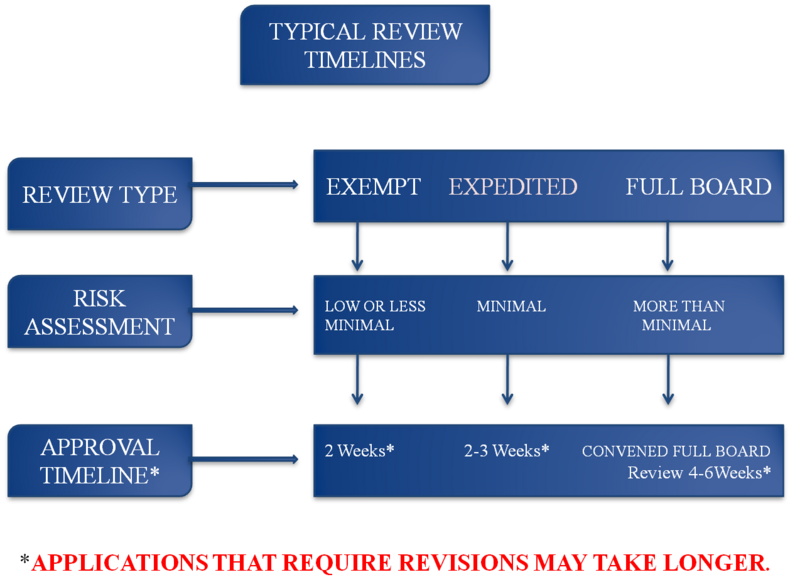
The submission is reviewed by at least one IRB member or in some cases, by a member of the ORRC. This review process can take up to 6 weeks depending on the type of review, complexity of the study, and availability of reviewers.
- Exempt Reviews may take up to 2 weeks
- Expedited Reviews (not to be mistaken with "quick" reviews) may take up to 3 weeks
- Full Board reviews may take up to 6 weeks
Post Review
Once the regulatory compliance review is complete, an outcome letter will be sent to the study PI and authorized study personnel indicating that the submission was approved/accepted, disapproved/unaccepted, requires revisions, may be approved pending the administrative review of given conditions, or the review has been tabled for a given reason. Depending on the outcome, further information may be requested prior to the full approval of the submission.
Education and Resources
Education
Resources
Forms and Tools
- iRIS Platform
- AI Policy
- Ethical IRB Guidelines and Principles
- GCP Training Requirement
- Guidance for Case Reports
- Guidance for Faculty and Research Staff
- Guidance on Recruitment Material
- Guidance: Student Research Guide
- IRB Charge Policy
- IRB Communication with the RSC
- IRB SOP
- IRB SOP Supplement
- IRB SOP DoD Addendum
- Limited IRB Review
- Review of PHI-Related Protocols
- Template: Assent Form (Download)
- Template: Informed Consent Form (Download)
- Template: Interview Preamble (Download)
- Template: Survey Preamble (Download)
- Typical IRB Review Timelines
Links
- 45 CFR 46: The Common Rule | eCFR
- 21 CFR 50: FDA regulations on the protection of human subjects | eCFR
- 21 CFR 56: FDA regulations on Institutional Review Boards (IRBs) | eCFR
- A How to Guide: The Use of Social Media in Research | NIH
- Belmont Report
- Human Research Protection Program Resources | HHS
- Office for Human Research Protections (OHRP) | HHS
ORRC staff serves Howard University faculty, staff, and students by helping them ensure that their research and teaching modules comply with all applicable federal, state, and local regulations and policies, as well as Howard University policies. ORRC staff are available to answer individual inquiries, meet with researchers and instructors, and to present and facilitate educational workshops and trainings.