
Research Security
It is the position of the Howard University (HU) Office of Regulatory Research Compliance (ORRC) that research conducted by the faculty, staff, and students must follow comprehensive policies, procedures, and safeguards to protect the integrity, confidentiality, and security of research conducted at HU. The ORRC Research Security Program, the ORRC works with other University entities to foster compliance with federal regulations to protect intellectual property and mitigate risks associated with research activities. This collaboration builds and maintains an effective research stronghold environment.
Main Objectives
- Protect national security by preventing the exploitation of U.S. research by foreign entities.
- Mitigate cybersecurity and intellectual property risks.
- Encourage research integrity and economic competitiveness by promoting transparency, ethical conduct, and trust.
- Maintain legal compliance by aligning with federal mandates such as NSPM-33 and the CHIPS and Science Act.
- Foster a culture of security awareness among researchers and staff.
What is Research Security?
Research security is process of safeguarding the research enterprise against the misappropriation of research and development to the detriment of national or economic security, related to violations of research integrity, and foreign government interference. Research Security ensures that research remains open and collaborative while safeguarding national interests.
Compliance with export control regulations is a core element of our Research Security Program through:
- Adherence to federal regulations such as International Traffic in Arms Regulations (ITAR) and Export Administration Regulations (EAR).
- Ensuring that all research personnel are familiar with export controls.
- Restricting the sharing of controlled research data with unauthorized parties such as maligned foreign actors.
- Monitoring export control compliance to foster safe and secure international partnerships.
How is Research Security Maintained?
Researchers are expected to demonstrate accountability when conducting for their research. They must report and disclose their actions to build trust and encourage integrity. Howard University requires that researchers and all key project personnel disclose the following:
- All contracts, agreements, and sources of research funding, both domestic and international, to determine any possible Financial Conflicts of Interest. Financial Conflict of Interest Disclosures may be submitted to the ORRC using the iRIS platform.
- Any foreign travel, collaborations with foreign agents (government, private entities, academic institutions, individuals), or Foreign Talent Program Participation (FTPP) to determine any possible Export Control concern. Export Control Disclosures may be initiated by first submitting an Export Control Assessment Form.
- All professional appointments, including foreign affiliations, to determine any possible Conflicts of Commitment.
The use of Digital Persistent identifiers (DPIs) such as ORCID iDs serve as "electronic CVs" and bolster security while reducing burden. DPI services include categories of information that can identify and avoid financial conflicts of interest and conflicts of commitment.
NSPM-333
The National Security Presidential Memorandum 33 (NSPM-33), published in 2021, directs enterprises that conduct research, including academic centers in the US to strengthen protections against undue foreign government influence and exploitation. The NSPM-33 expresses the need to enforce export control policies to not only encourage international collaborations and support international research projects but also to mitigate risks to protect intellectual property (IP), classified research, controlled unclassified research (CUI) and the transfer of materials as an effort to help preserve national security.
CHIPS and Science Act
The CHIPS and Science Act, enacted in 2022, includes provisions to strengthen research security by explaining the need for researchers to engage in mandatory annual training and certify non-participation in malign foreign talent programs. Though the act establishes and provides funding for the Creating Helpful Incentives to Produce Semiconductors (CHIPS) for America Fund to carry out activities relating to the creation of incentives to produce semiconductors in the United States, it also includes information on how to manage and mitigate research security risks.
The Adequacy of a Stronghold Environment
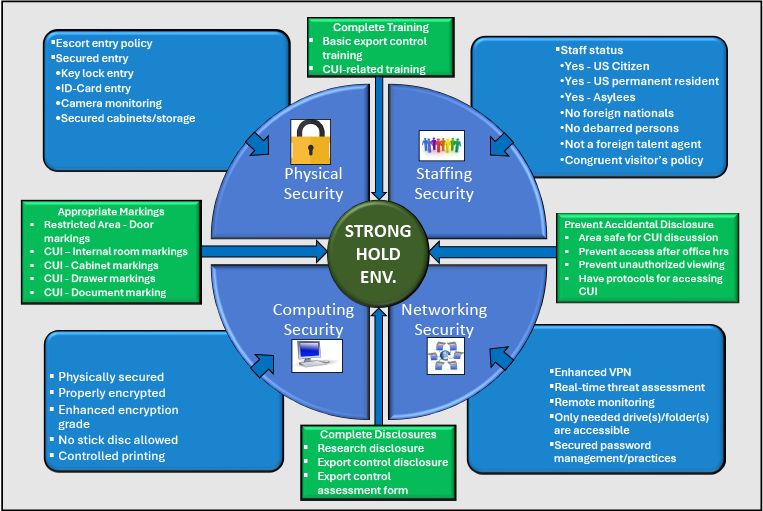
Training and Awareness
Cybersecurity Measures
Cybersecurity Measures HU Enterprise Technology Services (ETS)
The HU ETS develops and enforces policies on cybersecurity, computer security and email management: ETS Policies
All researchers working at Howard University must set up multi-factor authentication (MFA): Training Resources | Howard University Enterprise Technology Services
ETS requires quarterly security training for all HU personnel as part of the Cybersecurity Awareness Training policy. By completing the mandatory HU Cybersecurity training, we ensure that we promote ongoing awareness to update researchers on emerging threats.
ORRC Training Requirements
CITI Training
In addition to the mandatory cybersecurity training, the ORRC also requires that researchers and research personnel comply with completing the following CITI Program modules:
- Conflicts of Interest
- Export Control
- Information Privacy Security (IPS) for Researchers
- Research Security: Training (combined)
The ORRC highly recommends that researchers complete the NSF Research Security Training Modules 1-4: Research Security Training.
Physical Security Measures
Physical Security Measures (PFM and DPS)
Restrict access to research facilities with badge-based entry systems:
- Radiation Safety badge
Contact HU Physical Facilities Management Locksmith Services for access control systems for your research space: Requests | Physical Facilities Management
Incident Response and Reporting
In case of an emergency that adversely impacts your health and public safety contact:
HUDPS EMERGENCY: (202) 806-7777
Contact the ORRC if unauthorized access and data breaches of research data occurred:
Phone: (202) 865-8597
Email: theorrc@howard.edu
For IT Support contact Enterprise Technology Services (ETS):
Email: huhelpdesk@howard.edu
Phone Support: 202-806-2020
Hours of Operation: Monday – Friday, 8:30a until 5p
In-Person Service Desk ETS Walk Up: iLab Technology Center 2301 Georgia Ave NW, Washington, DC 20001
Hours of Operation: Monday – Friday, 9a until 5p